~ HAPPY FRIDAY ~

We have a lot of information in the blog this week! It is another another combination of two weeks with this blog. I was under the weather last weekend and didn't get to post a blog with the snow day Friday. It worked out perfectly because this was a short week for both groups with me being out on Monday and Valentine's Day fun around the school on Wednesday.
AROUND THE SCHOOL

February 19th: President's Day - No School
February 20th: Donations Due for Jump Rope for Heart
February 21st: Author Visit - Carolyn Crimi
February 22nd: Science Fair 6-7PM
February 26th - March 9th: ISTEP 3rd & 4th Grade
LANGUAGE ARTS
 1ST GRADE: LIPOGRAMS: This week we finished our lipograms. We came back together as a whole group and came up with a strategy to pick our letter for the lipogram. We looked at our piece of writing and counted out how many words we would change per each of our 5 letters.
  This led us to use the "I" because we only had to change 2 words. They needed a quick reminder that we could change a phrase and not just one word. Together we worked through the second lipogram. They began the third one on their own and it was great to see them strategies on the letter to choose. This gave them some time to brainstorm different words as they selected their letter for their lipogram.
Next it was onto our next lesson.


We will continue this lesson next week.
 2ND GRADE: THE TALE OF DESPEREAUX: The students were introduced to their new Novel...The Tale of Despereaux by Kate DiCamillo. This week we worked on some introductory activities for our novel.
  We started with our predictions. Again, they looked at the cover and made a prediction to our entire story. Then we completed a new prediction tracker. This one has us agree or disagree with a statement and then we must find proof throughout the story to go with the statement.
  This will either make our first statement true or we will have the option to change it based on our evidence. Then we worked on an activity comparing the idea of light and dark, which will be a theme throughout the story. Lastly, we brainstormed what it means to be a hero. It was interesting to see the different ideas to define a hero. We ended our introductory unit by completing our Venn Diagram comparing ourselves to a friend. After being introduced to some of the themes they will see in the story - they were finally ready to begin our story. This week we started our new novel.
HOMEWORK: Please read chapters 3 & 4. They have a sheet to write down any questions as they read. Plus, one to track connections.
 3RD GRADE: PERSUASIVE WRITING: This week we reviewed our T-Charts together. While walking through each one, we would vote on which story the children preferred with each element.
  This was a great way for the children to see visually which book they should select with the persuasion paper. We reviewed the rubric the children are using while composing their paragraphs. This led us into a brief review into our hamburger model. If they students follow their hamburger model, they will reach most of the points automatically with the rubric.
  As a class, we composed a thesis statement for each book. Then they used the remainder of their time to complete their hamburger model and turn it into a paragraph.
When they finished their paragraph we practiced peer editing. The students traded with a partner as an extra set of eyes to look over their grammar. Next week we will share our persuasive writing.
MATH
 1ST GRADE: We continued to practice our tree sorting skills. Our tree branches have grown and we were sorting multiple attributes on a tree. They really enjoyed our tree sorting game!
 The purpose of the Carroll diagram is to allow us to sort shapes in a visual graph. It is another way for the students to compare and contrast the different shapes and attributes. They are all doing very well with the new way of sorting.
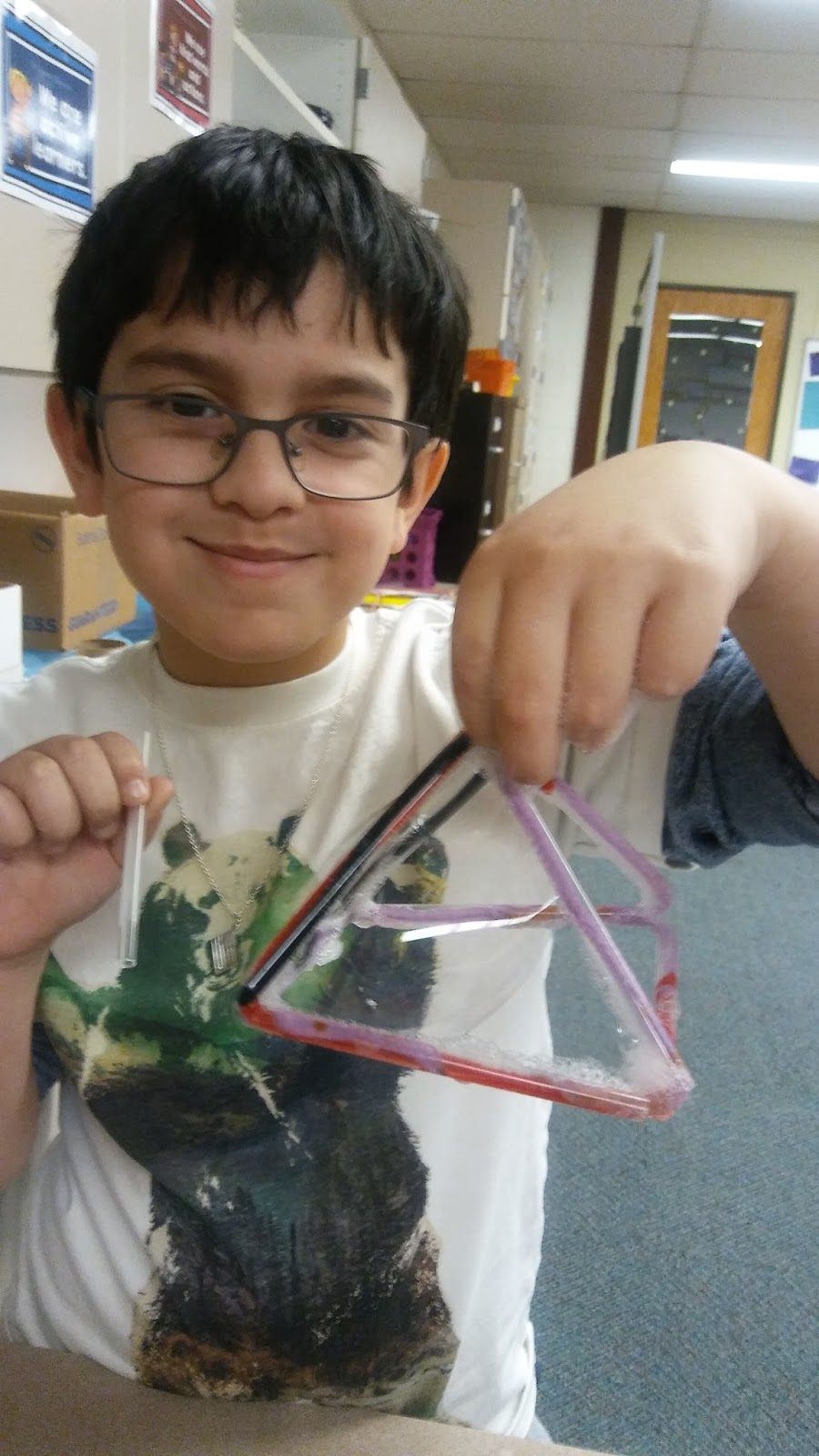
  2ND GRADE: 3D SHAPES: To focus on our 3D shapes we completed some SmartBoard activities. First, we completed one that helped us name our 3D shapes.
Then we worked on one that helped us count our attributes to the number of faces, edges and vertices. This was perfect practice that we completed together because it led into their independent work.


On their own, they had to use a shape and complete a chart filling in the numbers for the attributes for that shape.

We will continue to work with our 3D shapes and their attributes next week.
 3RD GRADE: ARROW PATTERNS: This was a fast lesson! The students were introduced to arrow math for solving patterns of a group of numbers in an array. We worked on this idea when we discovered the plus and minus rules of a number on the 100's chart.
 This time it was changed with the students given a smaller set of numbers arranged in a 7 by 5 array. The students needed to figure out the rule of what each arrow symbolized. After they completed the patterns for the arrow, the students were given a number and then told to follow the arrow pattern and fill in the number. They were given a challenge and we discussed what a pattern would look like if it cancelled out the pattern.
 This concept to undo a number led us into our Think Deeply response. On their own they were asked to explain how to undo arrow math and to show two examples of this.

They were very quick to realize that if you have arrows going in opposite directions they cancel each other out.
 4TH GRADE: REVIEW: Over the past two weeks, we have completed chapter 1. In small groups, they investigated for the solution of their Think Deeply. The Think Deeply question, required them to write out how they solved the problem - using words, pictures and equations.
 They have grown tremendously with their responses and amount of details they are including in their Think Deeply questions. Next it was onto some review before the Chapter Check-up.

We completed a few different SmartBoard activities to practice for the check-up. We reviewed equivalent fractions and the ordering of a set of fractions. Then it was time for the chapter check-up. The check-up allows us to monitor where they are at with the material we have covered before moving onto our next unit.
 If I see there is an area where all students struggled, we will take the time to review that material before moving forward. We will move onto our new chapter next week.
 Ms. Losinski

We will continue to work with our 3D shapes and their attributes next week.
 3RD GRADE: ARROW PATTERNS: This was a fast lesson! The students were introduced to arrow math for solving patterns of a group of numbers in an array. We worked on this idea when we discovered the plus and minus rules of a number on the 100's chart.
  This time it was changed with the students given a smaller set of numbers arranged in a 7 by 5 array. The students needed to figure out the rule of what each arrow symbolized. After they completed the patterns for the arrow, the students were given a number and then told to follow the arrow pattern and fill in the number. They were given a challenge and we discussed what a pattern would look like if it cancelled out the pattern.
  This concept to undo a number led us into our Think Deeply response. On their own they were asked to explain how to undo arrow math and to show two examples of this.
They were very quick to realize that if you have arrows going in opposite directions they cancel each other out.
 4TH GRADE: REVIEW: Over the past two weeks, we have completed chapter 1. In small groups, they investigated for the solution of their Think Deeply. The Think Deeply question, required them to write out how they solved the problem - using words, pictures and equations.
  They have grown tremendously with their responses and amount of details they are including in their Think Deeply questions. Next it was onto some review before the Chapter Check-up.
We completed a few different SmartBoard activities to practice for the check-up. We reviewed equivalent fractions and the ordering of a set of fractions. Then it was time for the chapter check-up. The check-up allows us to monitor where they are at with the material we have covered before moving onto our next unit.
 If I see there is an area where all students struggled, we will take the time to review that material before moving forward. We will move onto our new chapter next week.